From Raw Material to Recycled Paper: What Happens After the Bin
From raw material to recycled paper, see how collection and mill processes prepare used paper for new products, and how to sort household items correctly.
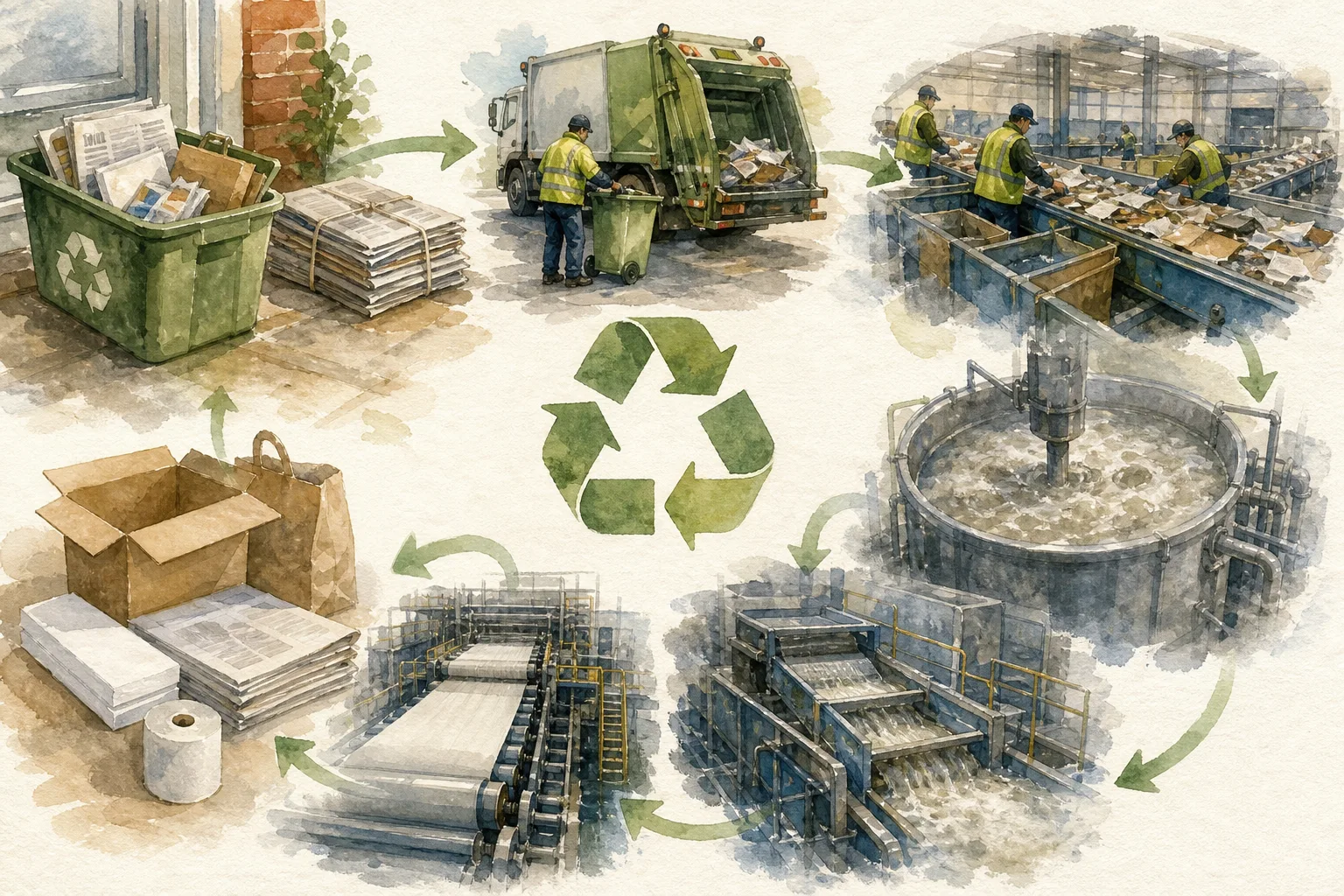
A flattened cereal box sits beside yesterday’s newspaper on collection morning. From raw material to recycled paper, the route begins with local collection rules and continues through sorting and mill processes that vary by facility.
Paper recycling is a chain of decisions, not a single machine. Collection gathers material; sorting separates it into grades; pulping loosens fibres in water; and papermaking forms prepared pulp into sheets or board. The route depends on the material received, the equipment available and the product a mill intends to make.
Collection rules shape what reaches the mill
A council or collection provider may ask for paper in a dedicated container or allow it alongside other recyclables. After collection, paper and card are separated from other materials and may be compacted for transport to a mill.
Local instructions matter because services differ in what they accept. A paper cup, for example, may have a lining unlike an uncoated sheet. A recycling symbol alone does not tell you whether your collection service takes it.
Keep accepted paper dry and follow the provider’s instructions about separating components. Do not dismantle an item unless the guidance asks you to; the local system may be able to handle parts that look difficult to separate at home.
Sorting groups paper by its construction and intended use
Newspapers, office paper, corrugated cardboard and cartons differ in their fibres, coatings and construction. A sorting facility separates incoming material according to its equipment and the grades it prepares. Depending on the plant, methods may include screens, air separation, optical systems or manual checks. No single method describes every facility.
Food, moisture, plastic film and loose rubbish can complicate handling or affect the pulp made from a load. A greasy takeaway box, for instance, may not suit ordinary paperboard recovery. Check local rules rather than assuming that every paper-based item belongs in the same container.
Once sorted, grades go to mills equipped to use them. A mill’s choice depends on the material received and the product planned. Some corrugated cardboard may be suitable for packaging board, while other products require different fibre qualities or preparation.
Pulping loosens paper into a mixture of fibres
At a mill, bales may be opened and fed into a pulper, a large vessel that mixes paper with water and agitation. The sheets loosen into a thick suspension called pulp. How the mill handles this stage depends on the incoming grade and its equipment.
Ink, adhesive, coatings and an item’s construction affect how it breaks apart and what cleaning may be needed. Pulping does not make every trace of the original object disappear. It creates a mixture of fibres and other material that can be separated further.
Say a hypothetical delivery contains flattened cardboard boxes and office sheets, with plastic tape on one box. If the collection accepts those items and sorting sends them to a suitable grade, pulping can loosen the paper fibres. Later screening may separate the tape as unwanted material; it is not part of the paper fibre mixture.
Cleaning prepares pulp for a particular product
After pulping, screens may catch larger pieces such as plastic fragments, staples or adhesive clumps. Other equipment can separate materials according to their physical properties. The aim is to prepare pulp for an intended product, not to make every batch identical.
For products that need a lighter appearance, a mill may use de-inking. Some processes use air bubbles to help separate ink particles; washing may also remove fine particles. The methods chosen depend on the material, grade and mill.
Cleaning produces residue that can include ink, coatings, grit and other contaminants. These materials do not vanish; facilities handle them through their own processes and applicable requirements. Recycling recovers useful fibres, not every component of an old paper product.
Fibre preparation depends on the paper being made
Cleaned pulp may be refined to change the surfaces of its fibres and help them bond as a sheet forms. A mill can mix pulp with water and may combine recovered fibres with other fibre sources or additives to meet a product’s requirements.
Recovered fibres may be altered by use and processing, but the extent and effect depend on the fibre, the material’s history and the mill’s methods. A mill therefore assesses whether a recovered grade suits its intended product; some products may use a blend of recovered and other fibres. There is no single fibre life or quality path that applies to every paper product.
A mill making brown packaging board may not need to remove every trace of ink. A product needing a lighter surface may call for different preparation or a different fibre mix. The process follows the material and intended use.
Papermaking forms prepared pulp into sheets or board
Prepared pulp is spread across a moving mesh, often called a forming wire. Water drains through it as fibres settle together. The wet sheet then passes through presses to remove more water and heated sections to dry it.
The material may be smoothed, coated or finished for its intended use. It can be wound into large rolls or cut into sheets. Packaging board, newsprint and office paper share the broad process of forming and drying fibres, but their surface and finishing needs differ.
The finished material is checked and prepared for a converter or manufacturer. It may become a box, printed sheet or paper bag. Its next recycling route depends on how it is made and which collection services accept it where it is used.
How should household paper be sorted?
Should paper be clean and dry?
Keep accepted paper dry and as free of food or liquid as possible. If an item is wet or dirty, check local guidance before adding it to a dry paper collection.
Do staples and envelope windows need removing?
Some processing systems can handle small staples or plastic windows, but the local provider’s directions take priority. Remove larger non-paper parts when the instructions ask you to.
Can greasy or coated paper go in the paper bin?
It depends on the item and the collection service. Grease, coatings and linings can affect recovery, so check the rules for takeaway packaging, cups and similar products.
Does every recycled sheet become another sheet?
No. Recovered fibres may become board or other products, and sorting and cleaning separate some material. The fibre grade and the next product’s needs influence what can be made.
Household paper sorting starts with observable checks
Check the provider’s current instructions, then look at the item’s condition and construction. Each observation should lead to a clear choice.
- Accepted material: If the local list names the paper or card, place it in the specified container; if it is excluded, follow the stated alternative or keep it out of that collection.
- Moisture: If the item is dry, sort it with accepted material; if it is wet, follow local advice or set it aside rather than adding it to a dry load.
- Food or oil: If the paper is clean, sort it as directed; if it is greasy or food-covered, use the local guidance for contaminated packaging instead.
- Attached parts: If the provider says to remove a non-paper part, take it off before sorting; if the instructions say it can remain, leave it attached.
- Coatings or linings: If local guidance accepts the coated item, put it in the named stream; if not, keep it out of ordinary paper collection and use the listed alternative.
- Paper versus card: If the service requires separate containers, divide the materials; if it permits a combined collection, place them together as instructed.
- Protection from rain: If the collection allows a covered bin or bag, keep accepted material sheltered; if it specifies another container, use that instead.
Imagine a hypothetical parcel arrives in a dry cardboard box with one plastic delivery sleeve attached. You check the council’s list and see that clean cardboard is accepted while the sleeve belongs in a separate household plastics stream. You remove the sleeve, flatten the box and place the card in its specified container. The observable result is a dry, flattened box separated from the sleeve and ready for the collection route assigned to accepted card. If the council’s list gave a different instruction, that instruction would determine the sorting decision instead.
Recovered paper can follow different fibre routes
Paper recycling recovers fibres, but it does not preserve every part of an old item or make every recovered fibre suitable for every product. Sorting separates grades, cleaning removes contaminants, and some material may leave the usable pulp stream. How much a fibre changes, and which products can use it, depends on its condition and the processes applied.
Keeping accepted paper dry and avoiding contamination can help it enter the route intended for that material. Products with straightforward paper construction may also be simpler to sort, but local collection rules remain the practical guide.
From raw material to recycled paper, collection gathers material, sorting separates grades, pulping loosens fibres, cleaning prepares them and papermaking forms a new product. For household paper sorting, check the local instructions and keep accepted material dry; the fibre’s next use then depends on its grade, condition and the mill’s process.