The Second Life of a Glass Jar
Glass jar reuse works best when the container suits its next job. Learn how to clean it, assess its limits and choose a useful everyday purpose.
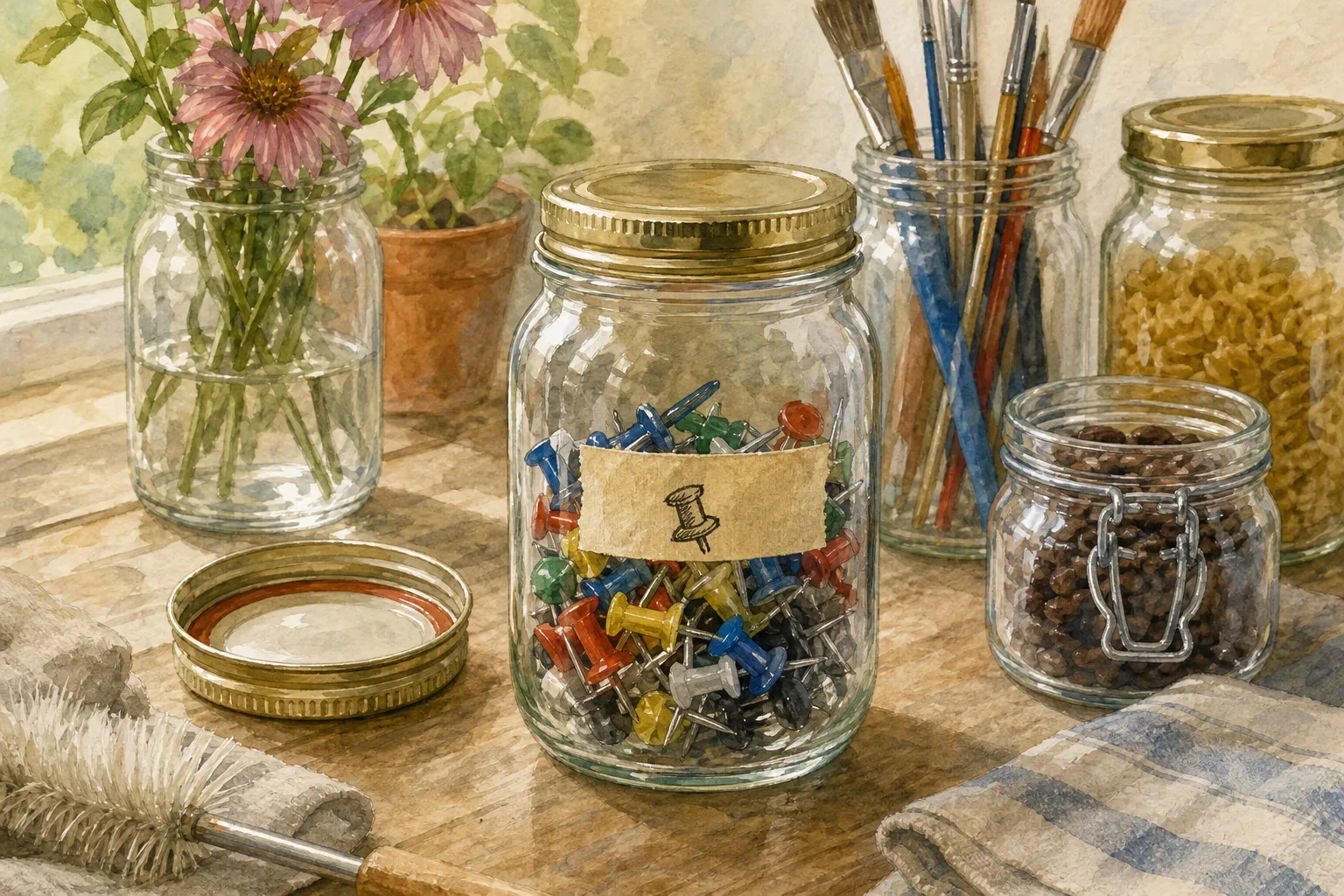
Glass jar reuse often begins beside the sink, with an empty pasta-sauce jar and its lid ready to be washed. Before choosing a new job for it, consider what the jar was designed to do and what you can observe about its condition.
Start with the jar’s original job
Food packaging is made for its original use, not automatically for every task a household might assign it later. A jar that held sauce may serve for dry craft materials or a bunch of flowers, but do not assume it can tolerate heating, pressure or sudden temperature changes.
For preserving food, use jars, lids and a tested method specified for that purpose. A retail twist-off lid that closes on its original jar is not evidence of a safe preserving seal. Follow the equipment maker’s directions and the preserving method’s instructions.
Keep the next use modest: choose a task that does not depend on heating, pressure or a seal the jar was not made to provide.
Inspect the glass, rim and lid
Look over the jar in good light. A crack, chip, sharp edge or damaged mouth rules it out as a household container. Do not run a finger across a suspected chip; set the jar aside carefully and follow local guidance for disposing of damaged glass.
Check the lid separately. Rust, dents, peeling coating or a damaged liner mean it should not be relied on for closure. Even a sound-looking lid may not fit a different jar that appears similar. If using the original lid for ordinary storage, check that it engages smoothly, sits level and does not catch. Do not force it.
Set an empty jar on the surface where it will live. If it wobbles, choose a steadier container for that spot rather than trying to stabilise the jar with loose objects.
Clean without asking the glass to take heat
Wash the jar and lid with washing-up liquid and warm water. A bottle brush can reach the shoulders; a cloth can clean the rim and the groove in the lid. Rinse well, then leave the parts to dry separately.
If residue or an odour remains, soak the jar in warm soapy water and wash it again. Use a suitable brush or cloth rather than a sharp knife or abrasive tool. Avoid sudden temperature changes: ordinary packaging may crack if exposed to them, and washing does not establish that a jar is suitable for heating.
For label adhesive, soak the jar and peel the softened paper away. Rub remaining glue with a cloth and washing-up liquid. A little cooking oil may loosen stubborn adhesive; wash the area afterwards and keep oil away from a lid’s sealing surface.
Give the jar a job that fits its shape
A wide mouth makes it easier to reach in and clean. Straight sides can make a label easier to read, while a stable base helps the jar sit on a shelf. Match the opening and shape to what you will put inside.
- Dry pantry storage: Check that the jar is clean, dry, intact and easy to identify; if all are true, use it for ordinary storage, and if not, wash it again or choose a different container.
- Small craft items: Check that the contents fit through the opening and can be retrieved; if they can, label the jar if needed, and if they cannot, choose a wider container.
- Pencils or brushes: Check that the jar stands steadily and has a smooth rim; if it does, use it as an open holder, and if it wobbles or has a sharp edge, choose a more stable holder.
- Flowers: Check that the glass is intact and the base sits securely; if so, use it as a vase, and if not, choose a sound vessel with a broader or steadier base.
- Ordinary closure: Check that the original lid is undamaged and turns on smoothly; if it does, use it only for routine storage, and if it catches or sits crooked, leave the jar open or choose another container.
- Food contents: Check that the jar is fully clean and dry and that the contents will be recognisable; if so, label it when needed, and if residue, odour or uncertainty remains, use another container or a non-food purpose.
- Heating or preserving: Check whether the task involves heat, pressure or a preserving seal; if it does, use equipment and instructions intended for that task, and if those are unavailable, do not use the retail jar for it.
For example, say you have a clean sauce jar with its original lid and a handful of drawing pins. You inspect the glass and rim, find no visible damage, wash and dry both parts, then check that the lid turns on evenly. You put the pins inside and label the jar; the result is a small-parts container with visible contents and a lid for ordinary storage. If the lid catches, you instead place the pins in a stable open holder, avoiding a closure that does not fit.
Which uses should you rule out?
Do not put chemicals, medicines or products that could be mistaken for food into an unlabelled food jar. Keep hazardous products in their original packaging, with their original labels and closures, and follow their safety directions. A reused food jar is not a substitute for packaging designed to identify and contain those products.
Do not use cracked or chipped glass where it could cut someone or spill its contents. Nor should a jar’s former food use be taken as evidence that it is suitable for heat, pressure or preserving. If the task depends on those properties, follow instructions for equipment designed for it.
What should you know before choosing a use?
Can a clean jar hold dry food?
For ordinary storage, check that it is intact, fully dry and easy to identify, and that its lid closes as intended. Do not use a retail jar as preserving equipment unless it is specified for the tested method you are following.
Can the original lid be reused?
It may close the original jar for routine storage if it is undamaged and turns on smoothly. That fit does not establish that it can form a preserving seal.
What if the jar still smells after washing?
Wash it again and let the jar and lid dry separately. If the odour remains, avoid uses where it could transfer to the contents; choose another purpose or follow local disposal guidance.
Can a food jar be heated?
Do not assume that ordinary food packaging can withstand heating or sudden temperature changes. Use only equipment and methods specified for the task, and follow the maker’s directions.
Glass jar reuse is easiest to manage when the intended job is visible in the choice: a stable open holder for brushes, or a clean, labelled jar for ordinary dry storage. Keep the lid with its original jar, and do not let an everyday fit stand in for equipment designed for a more demanding task.