What Makes a Definition Useful?
Learn how to write a useful definition that clarifies a term, separates it from nearby ideas and tells readers which meaning applies in context.
A recipe tells you to bring a sauce to a simmer, but the pot is bubbling hard. A useful definition of simmer helps you decide what to do with the heat. A definition should make a term recognisable and show which meaning applies.
The right wording depends on its purpose. A note for a new cook needs a clear description; a workplace policy may need conditions and exclusions. In both cases, readers need a boundary they can use.
A definition needs a clear setting
Scope means the range of cases a definition is intended to cover. A word can have a familiar everyday meaning and a narrower one in a particular field, document or place. Naming the setting prevents readers from applying the wrong sense.
For example, “public transport” might mean shared passenger services open to the public in everyday conversation. A local document could use the term more narrowly and exclude taxis or community shuttles. If that boundary matters, the document should state it.
For a recipe note, you might define a simmer as cooking a liquid over gentle heat, with small bubbles appearing rather than a strong rolling boil. That gives the reader something to look for and suggests lowering the heat if the pot is boiling vigorously. It is a plain-language explanation, not a substitute for food-safety guidance where safe handling or cooking temperatures matter.
Name the setting whenever readers could reasonably understand the term another way.
Choose a category and a distinguishing feature
A useful definition can begin by naming the kind of thing a term describes, then add the feature that separates it from nearby ideas. The category gives readers a starting point; the distinguishing feature makes the meaning more precise.
“A forecast is a prediction” gives a broad category, but says little about what makes a forecast distinctive. Calling it an estimate of what is likely to happen, based on available information and stated assumptions, gives the reader more to work with. A plan sets out intended actions; a promise expresses a commitment. In specialist settings, use the relevant field’s definitions.
Choose only the comparison that is likely to prevent confusion:
- Square and rectangle: A square has four equal sides and four right angles; a rectangle need not have equal sides.
- Budget and record: A budget plans income and spending; a record describes what has already happened.
- Rumour and confirmed report: A rumour is unverified information passed between people; a confirmed report has been checked against evidence.
These are everyday distinctions, not rules for every technical use. Where a specialist document supplies its own definitions, use those for that context.
How can you check whether a definition is clear?
Does it use words the reader understands?
A definition should not make readers look up another unfamiliar word to understand the first. Use plain language where possible, and explain a technical term if it is needed.
Does it identify the kind of thing being described?
Start with a category such as an object, process, quality or relationship. Then add a feature that narrows the meaning, since the category alone may cover too much.
Could a nearby idea fit the same wording?
Compare the definition with the most plausible neighbour. If both seem to fit, add the distinction that matters or state the context that changes the meaning.
Does the setting affect the meaning?
Check for an everyday sense, a specialised sense or a boundary set by a particular document. Name the field or document if that difference affects how readers should interpret the term.
Use observable features instead of circular wording
A circular definition repeats the term, or a close variation of it, without explaining the meaning. “A decision-maker is someone who makes decisions” leaves the reader asking what gives that person the role.
Replace the repetition with features a reader can recognise. In a particular organisation, a decision-maker might be someone authorised to choose between available options and approve the resulting action. This adds authority and consequence. Check the organisation’s own rules before using such wording as formal guidance.
Some ideas cannot be reduced to visible features. “Fairness”, for instance, can depend on values and context. A careful definition can state the principle being used and the setting in which it applies, without presenting one contested interpretation as universal.
Instead of “reliable means you can rely on it”, state the condition that matters in the context.
Match the amount of detail to the purpose
A casual explanation may need a plain category and one distinguishing feature. A classroom definition can add a contrast or example. A policy or technical document may need explicit conditions, exclusions and a way to handle borderline cases.
Definitions used in legal, medical or safety decisions need particular care. An informal explanation is not a substitute for applicable professional standards or advice from a qualified professional. When consequences matter, check the authoritative guidance for that setting.
An example can make an idea easier to picture, but it cannot settle every boundary. Calling timber a renewable resource, for instance, does not say which conditions or timescale count in a particular context. Include those qualifications only when the subject and applicable guidance support them.
Keep the central meaning easy to find. Put necessary qualifications in a separate sentence or note.
How does a boundary check shape a definition?
Test a draft against one case that should fit and one that should not. Then identify what evidence would resolve a case that remains unclear. The invented garden notice below shows how to make those decisions without guessing.
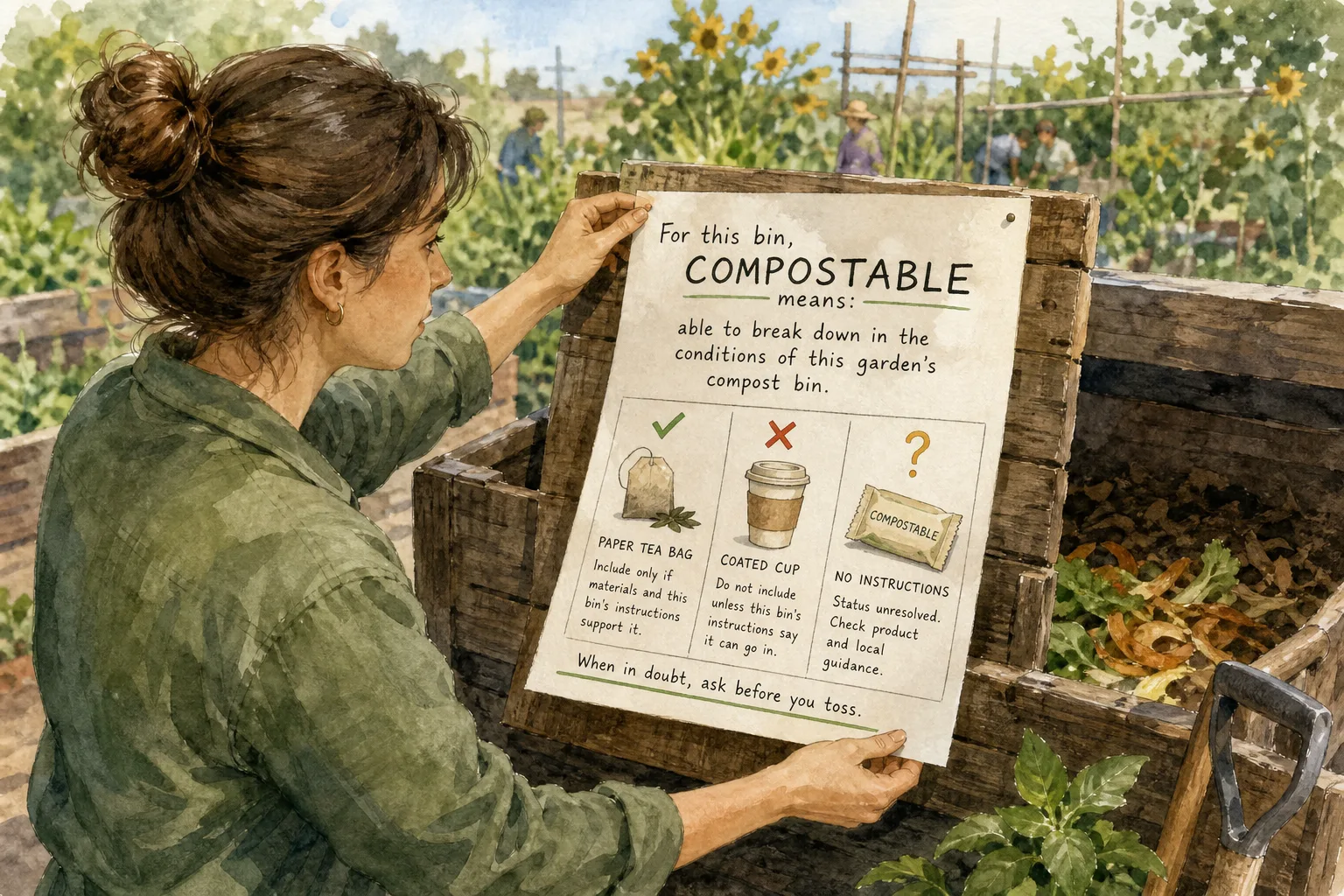
Imagine you are writing a fictional notice for a community garden’s compost bin. The notice needs to explain “compostable” for that bin, not every composting process. Your starting items are a paper tea bag, a plastic-coated takeaway cup and an item labelled “compostable” with no disposal instructions available.
You define the term as “able to break down in the conditions of this garden’s compost bin”. You include the tea bag only if its materials and the bin’s instructions support that use; otherwise, you leave it out. You exclude the coated cup unless applicable instructions for this bin say it can go in. For the item with missing instructions, you leave its status unresolved and direct readers to check the product and local guidance. The notice now gives a clear rule for the bin without treating an uncertain label as proof.
- Plain language: Check for unfamiliar terms. If one is essential, explain it; otherwise, replace it with simpler wording.
- Category: Check whether readers can tell if the term describes an object, process, quality or relationship. If not, name the category; if so, keep the definition concise.
- Distinguishing feature: Check whether a nearby concept also fits. If it does, add the difference that matters; if it does not, avoid an unnecessary contrast.
- Scope: Check whether the meaning changes by field, document or place. If it does, name that setting; if not, leave out a needless qualification.
- Circular wording: Check whether the definition repeats the term or its root. If it does, replace the repetition with an observable feature; if not, retain the clear wording.
- Borderline case: Check whether a plausible edge case has a clear answer. If not, state the missing condition or point to applicable guidance; if it does, use the definition as written.
- Consequences: Check whether misunderstanding could affect legal, medical or safety decisions. If it could, consult the relevant professional standard or a qualified professional; if it could not, keep the explanation proportionate to its informal use.
A useful definition gives readers enough to recognise a term and choose the right meaning for the setting. When you refine one, the phrase “useful definition” should prompt a final check: can a reader apply it, and can they see where its boundary lies?