Why Clear Instructions Often Start with an Action
Why instructions begin with a verb: see when an action-first sentence helps, when another form is clearer, and how wording shapes the reader’s next move.
A recipe card says, “Fold the parsley through the sauce.” The action arrives before any explanation, so the cook can begin at once. Why instructions begin with a verb is really a question about which sentence form makes the next move easiest to recognise.
Many instructions use an imperative, a verb form that addresses the reader without naming them: “Fold the parsley through the sauce.” But instructions do not all begin with verbs. A warning may start with “Caution”, and a careful procedure may begin with a condition such as “If the screen is blank”. Choosing the right opening depends on what the reader needs to notice first.
An action-first instruction makes the next move easy to spot
In a statement, the subject is usually named: “The cook folds the parsley through the sauce.” An imperative leaves out the understood subject, “you”, and puts the action first: “Fold the parsley through the sauce.” That compact structure suits a recipe, where the reader is already expecting a sequence of actions.
Starting with an action is especially useful when the reader needs to do something immediately. “Press the blue button” identifies both the action and its object. By contrast, “The blue button is used to start the machine” describes a function but does not directly tell the reader what to do.
Action-first wording is not automatically clearer. If a reader must check a condition before acting, put that condition first: “If the warning light is on, switch off the heater.” The opening tells the reader when the instruction applies.
Put the information the reader needs first, not a verb by habit.
Instructions use more than one grammatical form
An imperative is common, but other sentence forms can guide action. “Do not touch the wet paint” is a negative imperative. “Could you hold the door?” is a question that functions as a request. “The handle turns anticlockwise” is a statement that may help someone use an object, even though it does not directly command them.
Labels and notices can also communicate instructions without a verb. “No entry” prohibits access; “Emergency exit” identifies a route. A short noun phrase can be quicker to scan than a full sentence, particularly when the sign’s purpose is obvious from its location.
These forms differ in what they foreground. An imperative names an action, a question can make a request less direct, and a label may identify a rule or place. The best choice depends on whether the reader needs a command, an explanation, a warning or a point of reference.
Verb-first wording can sound firm, helpful or welcoming
The imperative does not carry one fixed social meaning. “Please leave the parcel by the side door” is a courteous request; “Leave the building now” is an urgent direction. The situation, vocabulary and relationship between speaker and reader all affect how the words sound.
Adding “please” can soften an instruction, but it does not necessarily make it optional. “Please keep the fire door closed” still states a requirement. If an action is required, say so plainly; if it is a suggestion, make that clear with wording such as “You could try…” or “Consider…”
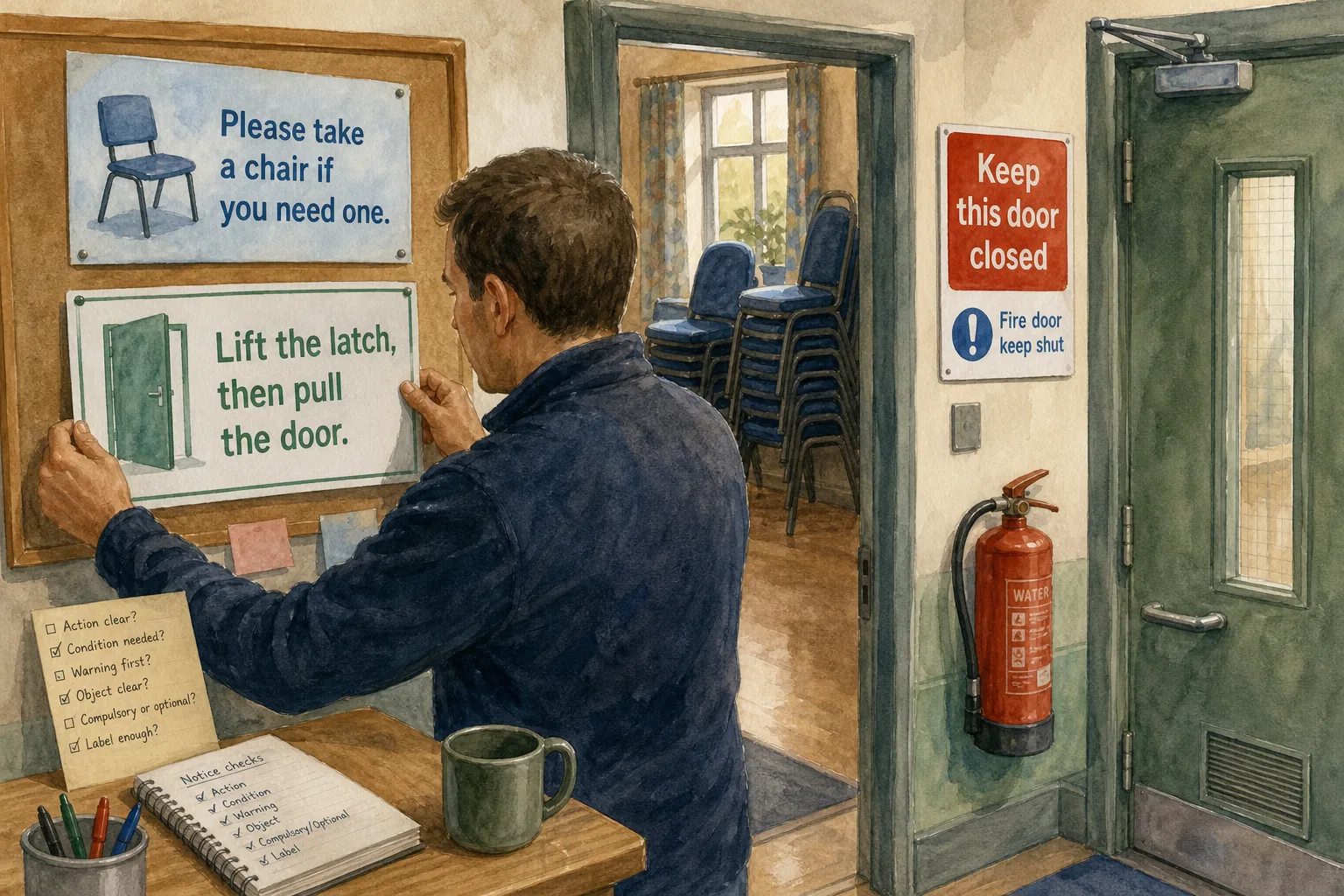
Say a fictional community hall manager is preparing two notices: one for a stack of spare chairs and another for a fire door. For the chairs, “Please take a chair if you need one” makes the offer clear. For the door, “Keep this door closed” states the required action directly. The difference in wording signals different expectations.
How should you choose an opening for an instruction?
When should an instruction start with a verb?
Start with an action when the reader already knows the context and needs to act. “Turn the tap off” is direct and easy to scan beside a sink.
When should a condition come first?
Put a condition first when it determines whether the action applies. “If the display is dark, check that the cable is connected” prevents the reader from treating the direction as universal.
Can a question give an instruction?
Yes. “Could you move the box?” is grammatically a question but can function as a request. Use this form when a courteous request fits better than a direct command.
Are signs always written as complete sentences?
No. “No entry” and “Staff only” are compact notices without an imperative verb. They work when the place and purpose make their meaning clear.
A quick review catches unclear instructions
Before using a direction in a recipe, notice or email, check what the reader must know and do. The following checks pair each observation with a decision, so the wording can be adjusted for its purpose.
- Check whether the reader can identify the required action; if not, begin with a specific verb such as “attach” or “turn”, then use a short explanation if needed.
- Check whether the action applies in every case; if it does not, state the condition first, then give the action only for that situation.
- Check whether a warning must be noticed before action; if it must, put the hazard or prohibition first, then state the safe next move where appropriate.
- Check whether the reader needs to know where or what to act on; if the object or location is unclear, name it, otherwise keep the direction concise.
- Check whether the action is compulsory or optional; if compulsory, use a direct instruction, and if optional, mark it as a suggestion or invitation.
- Check whether a short label could be mistaken for a full direction; if its meaning depends on context, add a verb-led sentence, otherwise keep the familiar label.
Imagine a fictional caretaker writing a notice for a side entrance. The starting details are that the entrance is open to visitors, the latch must be lifted before the door is pulled, and a sign saying “Side entrance” does not explain how to open it. First, the caretaker identifies the required actions: lift the latch, then pull the door. Next, the caretaker keeps the order visible by writing, “Lift the latch, then pull the door.” Finally, the caretaker checks that the notice does not imply the entrance is staff-only. The resulting wording gives visitors a usable sequence; keeping only “Side entrance” would identify the location but leave the opening action unstated.
Why instructions begin with a verb depends on the task
An action-first sentence is useful when the reader needs a direct next move. A condition-first sentence is better when the direction applies only in a particular situation, while a short label can work when a familiar rule is already clear. The imperative is one tool among these forms, not a rule that every instruction must follow.
When writing, read the sentence as if you have just arrived at the task. If you cannot tell what to do, when to do it or whether it is required, change the opening until that decision is clear.